

- Sowing the Future: Unlocking Kenya’s Agricultural Potential Through E-Agriculture;
By Hawkins Musili,
Kenya’s agricultural sector is evolving rapidly as technology reshapes how food is grown, managed, and marketed. With deliberate policy support and rapid innovation, the country is well positioned to lead Africa’s transition toward precision and climate-smart farming.
 A key milestone in this journey is the National Agroecology Strategy for Food System Transformation (2024–2033), which provides a framework for sustainable, data-driven agriculture anchored on climate resilience, digital innovation, and farmer inclusion.
Complementary initiatives such as the Kenya Integrated Agricultural Management Information System (KIAMIS) and digital input vouchers are already enhancing traceability, improving data collection, and delivering timely services to farmers.
 Similarly, the Kenya Carbon Market Regulation (2024) strengthens this ecosystem by linking productivity to climate action. Through accurate monitoring, reporting, and verification of carbon projects, the regulation positions drones and other digital tools as essential infrastructure for sustainable farming.
 At Fahari Aviation, a subsidiary of Kenya Airways, we are experiencing this transformation firsthand through the operational scaling of our agricultural drone program.
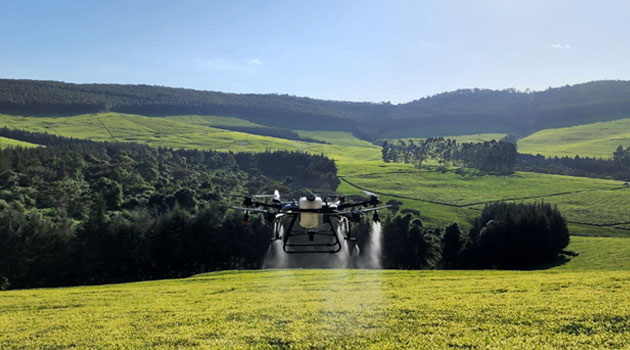
Our Unmanned Aircraft Systems (UAS) fleet now achieves coverage of up to 400 hectares per day, representing a fourfold increase in operational efficiency and field productivity.
 We have deployed precision drone-spraying solutions that optimize input application, reducing agrochemical usage by up to
45%, enhancing crop health monitoring, and significantly lowering labour costs.
In a country where agriculture sustains over 40% of the workforce and contributes approximately 33% to Kenya’s GDP, such data-driven innovations are contributing to measurable gains in productivity and rural economic resilience.
 According to the Kenya National Bureau of Statistics (KNBS), maize yields in drone-assisted farms have increased by 20–30% compared to traditional methods.
Globally, the opportunity is immense. Fortune Business Insights projects that the agriculture drone market will grow from USD 6.10 billion in 2024 to USD 23.78 billion by 2032, an annual growth rate of 18.5%.
 In Kenya, the drone market is expected to generate KSh 1.6 billion in revenue by 2025, with agriculture and wildlife conservation driving adoption.
This presents a chance for Kenya to become a regional hub for precision agriculture and climate-smart data services.Yet, critical barriers persist.
The digital divide still limits access in rural areas, where weak infrastructure and connectivity hinder the adoption of modern tools. Only 22% of rural households have reliable internet access, and fewer than 15% of smallholder farmers use digital platforms for agricultural decision-making.
 Public-private partnerships can bridge this gap by investing in data platforms, solar-powered drone hubs, and rural connectivity networks.
At the same time, county-level capacity gaps must be addressed.
Counties are central to implementing agricultural programs, yet many lack the technical expertise to manage data systems or interpret analytics.
 Targeted training, co-designed by government, academia, and the private sectorcan build essential competencies. For example, Fahari Aviation has partnered with local universities to train over 500 drone operators in agricultural applications since 2022.
Finally, sustained financing is crucial. Policy ambition must be matched by investment from government and development partners to scale successful pilots and ensure broad-based participation.
The Agricultural Sector Transformation and Growth Strategy (ASTGS) estimates that Kenya needs KSh 230 billion in annual investment to meet its food security goals by 2030.

To truly unlock Kenya’s food future, these efforts require coherence under a National EAgriculture Policy.
Such a policy would bridge digital divides, empower smallholder farmers, enhance market access through digital platforms, and provide timely weather and climate data for
informed decision-making.
By leveraging mobile applications, data analytics, and drones, Kenya can promote sustainable agriculture, improve livelihoods, and strengthen its agricultural GDP.
E-agriculture is no longer experimental, it is the future of farming.
The tools are ready. What’s needed now is commitment: connecting innovation with implementation so that every farmer, every hectare, and every county benefits from agriculture’s digital transformation.
The Author is the General Manager, Fahari Aviation