
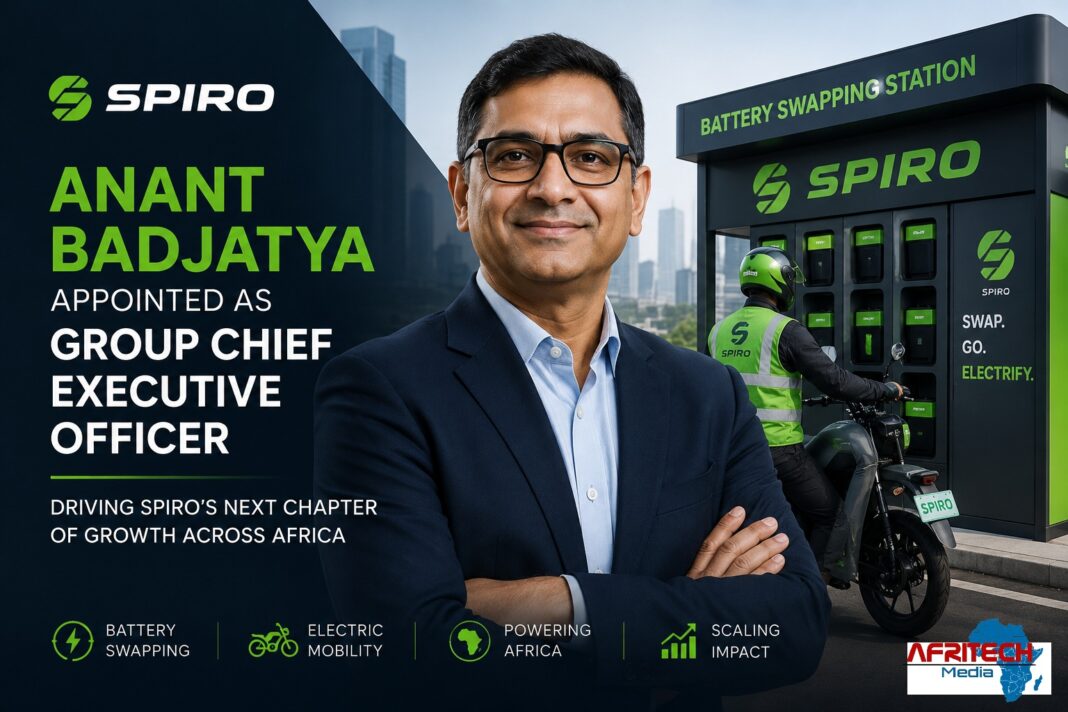

Spiro has appointed Anant Badjatya as its new Group Chief Executive Officer, marking a major leadership shift as the electric mobility company accelerates from infrastructure rollout into large-scale operational execution across Africa.
The appointment brings in a seasoned battery-swapping specialist at a pivotal moment for the company, which has rapidly expanded since its founding in 2022 and is now positioning itself for unicorn status.
Badjatya joins Spiro from Indofast Energy, a joint venture between IndianOil and SUN Mobility, where he helped build one of the world’s most extensive battery-swapping ecosystems.
During his tenure, he oversaw the rollout of more than 1,800 battery-swapping stations serving approximately 90,000 vehicles daily, giving him deep operational experience in high-volume, energy-as-a-service mobility systems.
That expertise aligns closely with Spiro’s current challenge: scaling a fast-growing electric mobility network across multiple African markets while maintaining reliability, affordability, and infrastructure density.
Timing aligned with aggressive expansion strategy
The leadership change comes shortly after Spiro secured a landmark $215 million equity raise backed by Impact Fund Denmark and Equitane, following a $50 million debt round just months earlier.
The funding momentum signals a transition from capital-intensive infrastructure build-out to execution at scale across multiple geographies and product lines.
Spiro founder and chairman Gagan Gupta described the appointment as a consolidation step for the company’s next growth phase, noting that Badjatya will help steer strategic execution across mobility, energy, and technology.
Rapid expansion across Africa
Spiro has emerged as one of Africa’s most aggressive electric mobility players, with operations spanning Kenya, Uganda, Rwanda, Nigeria, Benin, Togo, and Cameroon.
The company has deployed more than 100,000 electric motorcycles and established over 2,500 battery-swapping stations across the continent.
Its expansion pipeline now includes new target markets such as Ethiopia, Malawi, and Mali, as it pushes toward regional dominance in the electric two-wheeler ecosystem.
Kenya as a key growth market
Kenya remains central to Spiro’s Africa strategy. The company entered the market in 2023, starting in Mombasa before expanding into Nairobi and other regions.
By 2026, Spiro had deployed more than 16,000 electric motorcycles across Kenya, supported by over 400 battery-swapping stations spread across 22 counties.
The company also operates a local assembly facility and has committed approximately KES 13 billion toward scaling to 100,000 electric motorcycles and 1,000 swapping stations in the country.
Battery swaps take under five minutes and are accessible via a 24/7 mobile app, with stations strategically placed at petrol forecourts through partnerships with fuel retail networks such as Petrocity.
Riding on Kenya’s boda boda economy
The electric motorcycle transition is gaining momentum in Kenya’s boda boda sector, which remains the backbone of urban and peri-urban transport.
The country’s electric motorcycle market surpassed 30,000 units in 2025, with commercial riders driving most of the demand as operators seek lower running costs and reduced exposure to fuel price volatility.
Spiro’s model is designed specifically for this segment, combining affordable leasing structures with dense battery-swapping infrastructure that removes charging downtime entirely.
The execution test begins
With capital secured, infrastructure deployed, and markets expanding, Spiro now enters a more complex phase: operational consistency at scale across multiple countries.
Badjatya’s appointment signals a focus on systems discipline, network reliability, and execution efficiency as the company pushes toward a projected $1 billion valuation.
The challenge ahead is no longer just building infrastructure, but sustaining it across a rapidly growing continental footprint.