
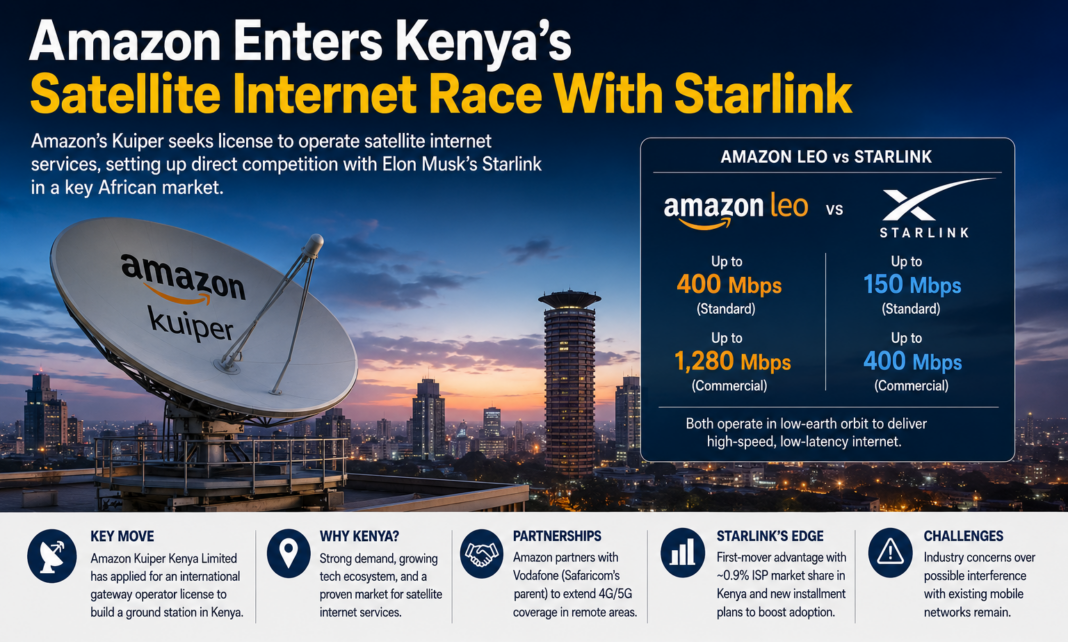

Amazon has applied for a license to operate satellite internet services in Kenya, setting the stage for direct competition with Elon Musk’s Starlink in one of Africa’s most dynamic digital markets.
The application, filed under Amazon Kuiper Kenya Limited, was published in a Kenya Gazette notice dated June 5 by the Communications Authority of Kenya (CA), confirming Amazon’s push to establish a formal operational footprint in the country.
The company is seeking an international gateway operator license, a regulatory approval that would allow it to build and operate a ground station in Kenya. This critical infrastructure connects satellites in orbit to terrestrial internet networks, enabling end-users to access broadband services.
If approved, this would mark Amazon’s first satellite ground station in Africa.
What a Satellite Ground Station Means for Internet Users
A ground station acts as the intermediary hub where satellite signals are received, processed, and relayed into fiber and mobile networks.
In practical terms, proximity matters. The closer the ground station is to users, the lower the latency and the faster the internet experience.
A similar improvement was recorded when Starlink established its Nairobi ground station in January last year. Latency dropped significantly from 296 milliseconds to 39 milliseconds, dramatically improving real-time applications such as video conferencing, streaming, and online gaming.
Amazon is seeking to replicate this advantage. Without a local station, satellite signals would have to be routed through facilities in other countries before reaching Kenyan users—adding delays and reducing performance.
Amazon Leo vs Starlink: A Growing Satellite Internet Rivalry
Amazon’s satellite internet project, formerly known as Project Kuiper and now branded Amazon Leo, is designed to compete directly with Starlink in the global low-earth orbit (LEO) broadband market.
The plan involves deploying more than 3,200 satellites by 2028, forming a global high-speed internet constellation.
Amazon has positioned its service as a high-performance alternative, advertising potential speeds of up to:
- 400 Mbps for standard user terminals
- 1,280 Mbps for enterprise-grade systems
By comparison, Starlink currently offers speeds of around 150 Mbps for standard users and up to 400 Mbps for premium or commercial packages.
Neither company has finalized pricing for the Kenyan market, though analysts expect aggressive competition as both firms target mass adoption.
Both networks operate in low-earth orbit, which significantly reduces latency compared to traditional satellite systems that rely on geostationary satellites positioned much further from Earth.
Amazon is also developing a direct-to-device connectivity model, which would allow smartphones to connect directly to satellites without relying on mobile towers—similar to capabilities already being explored by Starlink.
Why Kenya Is a Strategic Entry Point
Kenya has emerged as one of Africa’s most important test markets for satellite internet.
Starlink officially launched in the country in July 2023 and quickly demonstrated strong demand for reliable broadband, particularly in underserved rural and peri-urban regions.
The uptake has been strong enough to place Starlink among Kenya’s top internet service providers, holding an estimated 0.9% market share, ranking it ninth nationally.
Kenya’s relatively advanced digital ecosystem, combined with gaps in rural connectivity, has made it a natural entry point for satellite-based broadband services.
Amazon had already taken a preliminary step last month by applying for a Network Facilities Provider license, signaling broader plans to establish communications infrastructure in the country.
A ground station in Nairobi would also allow Amazon to serve neighbouring East African markets more efficiently through a regional hub.
On the partnership front, Amazon has signed a deal with Vodafone, the parent company of Safaricom, aimed at integrating satellite connectivity with existing 4G and 5G infrastructure in remote areas.
Starlink’s parent company, SpaceX, has also pursued similar partnerships with Vodacom and Airtel Africa, as competition for rural connectivity intensifies across the continent.
Starlink’s Head Start and Market Position
Starlink currently enjoys a first-mover advantage in Kenya’s satellite broadband space and has been actively reinforcing its position.
Earlier this year, the company introduced installment payment options for its hardware kits in a bid to lower entry barriers for new users and expand adoption.
It has also adjusted its operational requirements, including stricter identity verification rules for users, as part of efforts to streamline service delivery and compliance.
Regulatory Outlook and Industry Concerns
If approved, Amazon’s entry would bring the number of major satellite ground stations in Kenya to at least three, alongside facilities operated by the Kenya Space Agency and Starlink.
However, the expansion of satellite internet services has not been without concerns.
Telecom industry stakeholders have raised questions about potential signal interference from high-power satellite systems, warning that this could impact the performance of existing 3G, 4G, and 5G networks operated by providers such as Safaricom, Airtel Kenya, and Telkom Kenya.
There are also broader concerns about spectrum congestion, with experts cautioning that increased satellite activity could reduce the efficiency of terrestrial mobile networks that still carry the majority of internet traffic in the country.
What Happens Next
The Communications Authority of Kenya has not yet announced a timeline for reviewing or approving Amazon’s application.
If approved, Kenya is likely to become one of the most competitive satellite internet markets in Africa, with both Amazon and Starlink vying for dominance in a rapidly evolving connectivity space.