
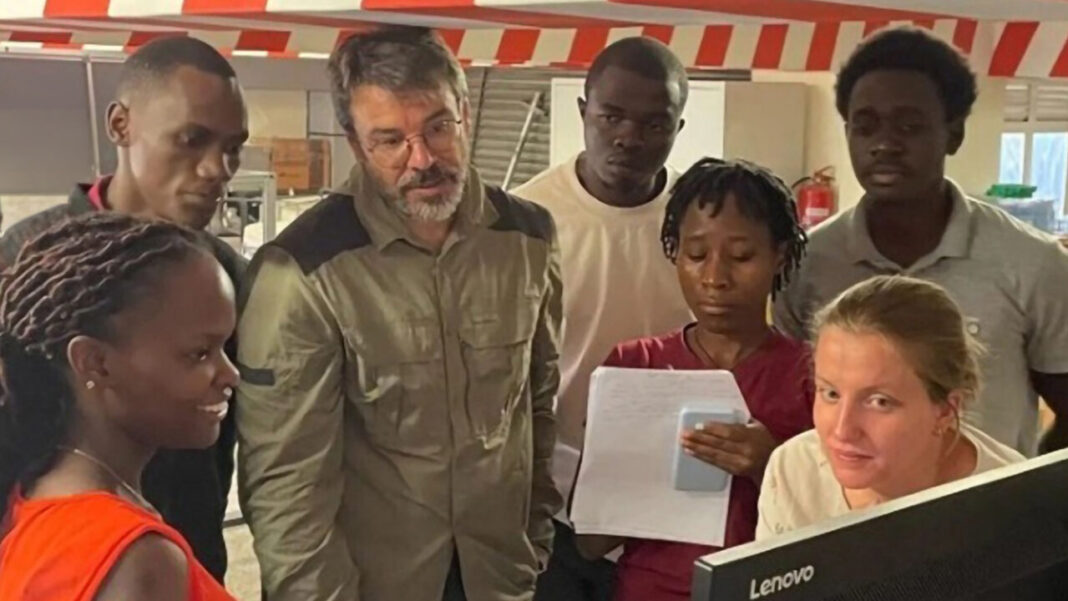

Researchers from Spain and Uganda are leveraging Microsoft Research’s cloud-based imaging platform, Tyger, to significantly improve the quality of MRI scans produced by ultra-low-field systems. The breakthrough could expand access to advanced medical imaging in underserved communities across Africa, where infrastructure limitations have long restricted diagnostic capacity.
The initiative is a collaboration between the Institute of Instrumentation for Molecular Imaging (I3M) in Spain and Mbarara University of Science and Technology (MUST) in Uganda, with support from Microsoft Research’s Health Futures division.
Overcoming MRI Imaging Challenges in Low-Resource Settings
While ultra-low-field MRI systems can successfully capture raw magnetic signals, converting those signals into clear diagnostic images has remained a major challenge. Issues such as noise interference, limited computing power, and inadequate infrastructure often result in low-quality outputs that are difficult to interpret.
In many parts of Sub-Saharan Africa, access to MRI services is already limited. Patients frequently travel long distances for scans, and in some regions, the nearest imaging facility may be hundreds of kilometres away.
The Spain–Uganda collaboration set out to change this by rethinking how MRI data is processed.
How Microsoft’s Tyger Platform Works
The project uses Tyger, an open-source platform developed by Microsoft Research, to shift computationally intensive MRI reconstruction and image enhancement to the cloud.
Instead of relying on expensive on-site computing systems, raw MRI signals are transmitted to Microsoft Azure, where they are processed using advanced algorithms. These include denoising models such as SNRAware, also developed by Microsoft Research.
Once processed, the system returns significantly clearer and more interpretable images to researchers and clinicians.
This cloud-first approach allows ultra-low-field MRI scanners to function primarily as signal-capturing devices, while the heavy image reconstruction work happens remotely.
Improved Image Quality and Clinical Potential
The results of the collaboration have been promising. Researchers report that reconstructed images show marked improvements in clarity, making them more suitable for diagnostic interpretation.
According to Michael Hansen, General Manager of Medical Imaging at Microsoft Research Health Futures, cloud-enabled reconstruction is helping remove long-standing barriers in medical imaging.
He noted that cloud computing allows researchers to produce higher-quality MRI images without depending on expensive local infrastructure—opening new opportunities for improved healthcare delivery in underserved regions.
Addressing Critical Healthcare Gaps in Uganda
In Uganda, the impact of delayed or inaccessible imaging can be severe. Conditions such as strokes, traumatic brain injuries, and hydrocephalus require rapid diagnosis, where even small delays can affect patient outcomes.
Eng. Dr. Johnes Obungoloch, Dean of the Faculty of Applied Sciences and Technology at MUST, emphasized the real-world significance of the project.
He explained that for many patients, travelling to distant hospitals for MRI scans is simply not feasible. Technologies like Tyger could help bring advanced diagnostic capabilities closer to local communities that have historically lacked access.
From Limited Scans to Full-Head Imaging
The collaboration, which began in 2023 after discussions between I3M and Microsoft Research, has evolved into an active research and testing programme.
At MUST, teams have been integrating the Ugandan MRI system into Tyger’s cloud-based pipeline while refining reconstruction techniques for low-resource environments.
Since 2025, researchers have scanned dozens of volunteers. Early trials were limited to partial head imaging, but improvements in processing and reconstruction have enabled full-head imaging with much higher clarity.
Building Local Skills and Research Capacity
Beyond technical improvements, the project is also strengthening local expertise in medical imaging and engineering.
Students and healthcare workers at MUST are being trained in MRI technology, signal processing, electronics, and image reconstruction techniques. This hands-on experience is helping build a new generation of researchers and technicians in Uganda’s medical technology sector.
The initiative is also contributing to broader scientific capacity-building in East Africa by integrating practical training with cutting-edge research.
Cloud Computing as the Future of Medical Imaging
Microsoft Research describes Tyger as a flexible architecture where hardware, software, and cloud-based workflows work together to improve imaging outcomes. By sharing computational resources across the cloud, the platform reduces dependence on expensive local systems while improving image quality.
The collaboration between I3M and MUST demonstrates how cloud computing and AI-driven reconstruction can help bridge critical gaps in global healthcare infrastructure.
If widely adopted, such technologies could play a key role in making high-quality diagnostic imaging more accessible across low-resource regions, ultimately improving early detection and patient care outcomes.